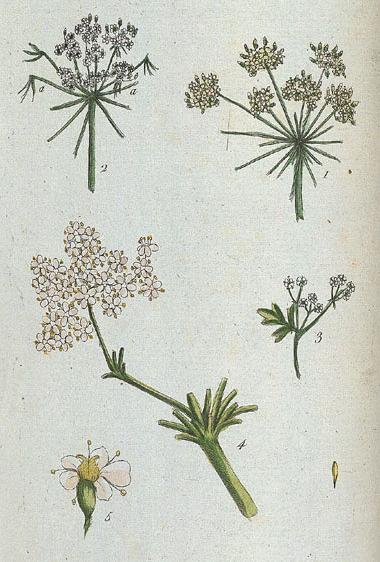
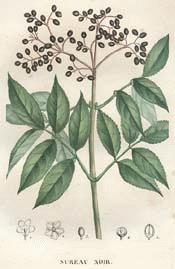
 |
Elder
(Sambucus nigra LINN.)
Click on graphic for larger image |
The Elder, with its flat-topped masses of creamy-white, fragrant blossoms, followed by large drooping bunches of purplish-black, juicy berries, is a familiar object in English countryside and gardens. It has been said, with some truth, that our English summer is not here until the Elder is fully in flower, and that it ends when the berries are ripe.
The word 'Elder' comes from the Anglo-Saxon word
aeld. In Anglo-Saxon days we find the tree called Eldrun, which becomes Hyldor and Hyllantree in the fourteenth century. One of its names in modern German - Hollunder - is clearly derived from the same origin. In Low-Saxon, the name appears as Ellhorn.
Æld meant 'fire,' the hollow stems of the young branches having been used for blowing up a fire: the soft pith pushes out easily and the tubes thus formed were used as pipes - hence it was often called Pipe-Tree, or Bore-tree and Bour-tree, the latter name remaining in Scotland and being traceable to the Anglo-Saxon form, Burtre.
The generic name
Sambucus occurs in the writings of Pliny and other ancient writers and is evidently adapted from the Greek word
Sambuca, the Sackbut, an ancient musical instrument in much use among the Romans, in the construction of which, it is surmised, the wood of this tree, on account of its hardness, was used. The difficulty, however, of accepting this is that the Sambuca was a stringed instrument, while anything made from the Elder would doubtless be a wind instrument, something of the nature of a Pan-pipe or flute. Pliny records the belief held by country folk that the shrillest pipes and the most sonorous horns were made of Elder trees which were grown out of reach of the sound of cock-crow. At the present day, Italian peasants construct a simple pipe, which they call
sampogna, from the branches of this plant.
The popular pop-gun of small boys in the country has often been made of Elder stems from which the pith has been removed, which moved Culpepper to declare: 'It is needless to write any description of this (Elder), since every boy that plays with a pop-gun will not mistake another tree for the Elder.' Pliny's writings also testify that pop-guns and whistles are manufactures many centuries old!
[
Top]
 |
Elder
(Sambucus nigra LINN.)
Click on graphic for larger image |
---History---A wealth of folk-lore, romance and superstition centre round this English tree. Shakespeare, in
Cymbeline, referring to it as a symbol of grief, speaks slightingly of it as 'the stinking Elder,' yet, although many people profess a strong dislike to the scent of its blossom, the shrub is generally beloved by all who see it. In countrysides where the Elder flourishes it is certainly one of the most attractive features of the hedgerow, while its old-world associations have created for it a place in the hearts of English people.
- In Love's Labour Lost reference is made to the common medieval belief that 'Judas was hanged on an Elder.' We meet with this tradition as far back in English literature as Langland's Vision of Piers Plowman (middle of the fourteenth century, before Chaucer):
- 'Judas he japed with Jewen silver
- And sithen an eller hanged hymselve.'
Why the Elder should have been selected as a gallows for the traitor Apostle is, considering the usual size of the tree, puzzling; but Sir John Mandeville in his travels, written about the same time, tells us that he was shown 'faste by' the Pool of Siloam, the identical 'Tree of Eldre that Judas henge himself upon, for despeyr that he hadde, when he solde and betrayed oure Lord.' Gerard scouts the tradition and says that the Judas-tree (
Cercis siliquastrum) is 'the tree whereon Judas did hange himselfe.'
- Another old tradition was that the Cross of Calvary was made of it, and an old couplet runs:
- 'Bour tree - Bour tree: crooked rong
- Never straight and never strong;
- Ever bush and never tree
- Since our Lord was nailed on thee.'
- In consequence of these old traditions, the Elder became the emblem of sorrow and death, and out of the legends which linger round the tree there grew up a host of superstitious fancies which still remain in the minds of simple country folk. Even in these prosaic days, one sometimes comes across a hedge-cutter who cannot bring himself to molest the rampant growth of its spreading branches for fear of being pursued by ill-luck. An old custom among gypsies forbade them using the wood to kindle their camp fires and gleaners of firewood formerly would look carefully through the faggots lest a stick of Elder should have found its way into the bundle, perhaps because the Holy Cross was believed to have been fashioned out of a giant elder tree, though probably the superstitious awe of harming the Elder descended from old heathen myths of northern Europe. In most countries, especially in Denmark, the Elder was intimately connected with magic. In its branches was supposed to dwell a dryad, Hylde-Moer, the Elder-tree Mother, who lived in the tree and watched over it. Should the tree be cut down and furniture be made of the wood, Hylde-Moer was believed to follow her property and haunt the owners. Lady Northcote, in The Book of Herbs, relates:
- 'There is a tradition that once when a child was put in a cradle of Elder-wood, HyldeMoer came and pulled it by the legs and would give it no peace till it was lifted out Permission to cut Elder wood must always be asked first and not until Hylde-Moer has given consent by keeping silence, may the chopping begin.'
- Arnkiel relates:
- 'Our forefathers also held the Ellhorn holy wherefore whoever need to hew it down (or cut its branches) has first to make request "Lady Ellhorn, give me some of thy wood and I will give thee some of mine when it grows in the forest" - the which, with partly bended knees, bare head and folded arms was ordinarily done, as I myself have often seen and heard in my younger years.'
- Mr. Jones (quoted in The Treasury of Botany), in his Notes on Certain Superstitions in the Vale of Gloucester, cites the following, said to be no unusual case:
- 'Some men were employed in removing an old hedgerow, partially formed of Eldertrees. They had bound up all the other wood into faggots for burning, but had set apart the elder and enquired of their master how it was to be disposed of. Upon his saying that he should of course burn it with the rest, one of the men said with an air of undisguised alarm, that he had never heard of such a thing as burning Ellan Wood, and in fact, so strongly did he feel upon the subject, that he refused to participate in the act of tying it up. The word Ellan (still common with us) indicates the origin of the superstition.'
- In earlier days, the Elder Tree was supposed to ward off evil influence and give protection from witches, a popular belief held in widely-distant countries. Lady Northcote says:
- 'The Russians believe that Elder-trees drive away evil spirits, and the Bohemians go to it with a spell to take away fever. The Sicilians think that sticks of its wood will kill serpents and drive away robbers, and the Serbs introduce a stick of Elder into their wedding ceremonies to bring good luck. In England it was thought that the Elder was never struck by lightning, and a twig of it tied into three or four knots and carried in the pocket was a charm against rheumatism. A cross made of Elder and fastened to cowhouses and stables was supposed to keep all evil from the animals.'
- In Cole's Art of Simpling (1656) we may read how in the later part of the seventeenth century:
- 'in order to prevent witches from entering their houses, the common people used to gather Elder leaves on the last day of April and affix them to their doors and windows,'
- and the tree was formerly much cultivated near English cottages for protection against witches .
- The use of the Elder for funeral purposes was an old English custom referred to by Spenser,
- 'The Muses that were wont green Baies to weave,
- Now bringen bittre Eldre braunches seare.'
- -------Shepheard's Calendar - November.
- And Canon Ellacombe says that in the Tyrol:
- 'An Elder bush, trimmed into the form of a cross, is planted on a new-made grave, and if it blossoms, the soul of the person Iying beneath it is happy.'
Green Elder branches were also buried in a grave to protect the dead from witches and evil spirits, and in some parts it was a custom for the driver of the hearse to carry a whip made of Elder wood.
In some of the rural Midlands, it is believed that if a child is chastised with an Elder switch, it will cease to grow, owing, in this instance, to some supposed malign influence of the tree. On the other hand, Lord Bacon commended the rubbing of warts with a green Elder stick and then burying the stick to rot in the mud, and for erysipelas, it was recommended to wear about the neck an amulet made of Elder 'on which the sun had never shined.'
- In Denmark we come across the old belief that he who stood under an Elder tree on Midsummer Eve would see the King of Fairyland ride by, attended by all his retinue. Folkard, in Plant-Lore, Legends and Lyrics, relates:
- 'The pith of the branches when cut in round, flat shapes, is dipped in oil, lighted, and then put to float in a glass of water; its light on Christmas Eve is thought to reveal to the owner all the witches and sorcerers in the neighbourhood';
- and again,
- 'On Bertha Night (6th January), the devil goes about with special virulence. As a safeguard, persons are recommended to make a magic circle, in the centre of which they should stand, with Elderberries gathered on St. John's night. By doing this, the mystic Fern-seed may be obtained, which possesses the strength of thirty or forty men.'
This is a Styrian tradition.
The whole tree has a narcotic smell, and it is not considered wise to sleep under its shade. Perhaps the visions of fairyland were the result of the drugged sleep! No plant will grow under the shadow of it, being affected by its exhalations.
Apart from all these traditions, the Elder has had from the earliest days a firm claim on the popular affection for its many sterling virtues.
[
Top]
---Uses---Its uses are manifold and important. The wood of old trees is white and of a fine, close grain, easily cut, and polishes well, hence it was used for making skewers for butchers, shoemakers' pegs, and various turned articles, such as tops for angling rods and needles for weaving nets, also for making combs, mathematical instruments and several different musical instruments, and the pith of the younger stems, which is exceedingly light, is cut into balls and is used for electrical experiments and for making small toys. It is also considerably used for holding small objects for sectioning for microscopical purposes.
- In a cutting of Worlidge's Mystery of Husbandry (dated 1675) the Elder is included in the 'trees necessary and proper for fencing and enclosing of Lands.'
- 'A considerable Fence,' he writes, 'may be made of Elder, set of reasonable hasty Truncheons, like the Willow and may be laid with great curiosity: this makes a speedy shelter for a garden from Winds, Beasts and suchlike injuries,'
- though he adds and emphasizes with italics, 'rather than from rude Michers.'
- The word 'micher' is now obsolete, but it means a lurking thief, a skulking vagabond. By clipping two or three times a year, an Elder hedge may, however, be made close and compact in growth. There is an old tradition that an Elder stake will last in the ground longer than an iron bar of the same size, hence the old couplet:
- 'An eldern stake and a black thorn ether (hedge)
- Will make a hedge to last for ever.'
- The leaves have an unpleasant odour when bruised, which is supposed to be offensive to most insects, and a decoction of the young leaves is sometimes employed by gardeners to sprinkle over delicate plants and the buds of the flowers to keep off the attacks of aphis and minute caterpillars. Moths are fond of the blossoms, but it was stated by Christopher Gullet (Phil. Trans., 1772, LXII) that if turnips, cabbages, fruit trees or corn be whipped with bunches of the green leaves, they gain immunity from blight. Though this does not sound a very practical procedure, there is evidently some foundation for this statement, as the following note which appeared in the Chemist and Druggist, January 6, 1923, would seem to prove:
- 'A liquid preparation for preventing, and also curing, blight in fruit trees, wherein the base is a liquid obtained by boiling the young shoots of the Elder tree or bush, mixed with suitable proportions of copper sulphate, iron sulphate, nicotine, soft soap, methylated spirit and slaked lime.'
The leaves, bruised, if worn in the hat or rubbed on the face, prevent flies settling on the person. In order to safeguard the skin from the attacks of mosquitoes, midges and other troublesome flies, an infusion of the leaves may be dabbed on with advantage. Gather a few fresh leaves from the elder, tear them from their stalks and place them in a jug, pouring boiling water on them and covering them at once, leaving for a few hours. When the infusion is cold, it is fit for use and should be at once poured off into a bottle and kept tightly corked. It is desirable to make a fresh infusion often. The leaves are said to be valued by the farmer for driving mice away from granaries and moles from their usual haunts.
The bark of the
older branches has been used in the Scotch Highlands as an ingredient in dyeing black, also the
root. The
leaves yield, with alum, a green dye and the
berries dye blue and purple, the Juice yielding with alum, violet; with alum and salt, a lilac colour.
The botanist finds in this plant an object of considerable interest, for if a twig is partially cut, then cautiously broken and the divided portions are carefully drawn asunder, the spiral air-vessels, resembling a screw, may be distinctly seen.
Linnaeus observed that sheep eat the leaves, also cows, but that horses and goats refuse it. If sheep that have the foot-rot can get at the bark and young shoots, they will cure themselves. Elderberries are eaten greedily by young birds and pigeons, but are said to have serious effects on chickens: the flowers are reported to be fatal to turkeys, and according to Linnaeus, also to peacocks.
Elder Flowers and Elder Berries have long been used in the English countryside for making many home-made drinks and preserves that are almost as great favourites now as in the time of our great-grandmothers. The berries make an excellent home-made wine and winter cordial, which improves with age, and taken hot with sugar, just before going to bed, is an old-fashioned and wellestablished cure for a cold.
In Kent, there are entire orchards of Elder trees cultivated solely for the sake of their fruit, which is brought regularly to market and sold for the purpose of making wine. The berries are not only used legitimately for making Elderberry Wine, but largely in the manufacture of so-called British wines - they give a red colour to raisin wine - and in the adulteration of foreign wines. Judiciously flavoured with vinegar and sugar and small quantities of port wine, Elder is often the basis of spurious 'clarets' and 'Bordeaux.' 'Men of nice palates,' says Berkeley (
Querist, 1735), 'have been imposed on by Elder Wine for French Claret.' Cheap port is often faked to resemble tawny port by the addition of Elderberry juice, which forms one of the least injurious ingredients of factitious port wines. Doctoring port wine with Elderberry juice seems to have assumed such dimensions that in 1747 this practice was forbidden in Portugal, even the cultivation of the Elder tree was forbidden on this account. The practice proving so lucrative, however, is by no means obsolete, but as the berries possess valuable medicinal properties, this adulteration has no harmful results. The circumstances under which this was proved are somewhat curious. In 1899 an American sailor informed a physician of Prague that getting drunk on genuine, old, dark-red port was a sure remedy for rheumatic pains. This unedifying observation started a long series of investigations ending in the discovery that while genuine port wine has practically no anti-neuralgic properties, the cheap stuff faked to resemble tawny port by the addition of elderberry juice often banishes the pain of sciatica and other forms of neuralgia, though of no avail in genuine neuritis. Cases of cure have been instanced after many tests carried out by leading doctors in Prague and other centres abroad, the dose recommended being 30 grams of Elderberry juice mixed with 10 grams of port wine.
The Romans, as Pliny records, made use of it in medicine, as well as of the Dwarf Elder (
Sambucus Ebulus). Both kinds were employed in Britain by the ancient English and Welsh leeches and in Italy in the medicine of the School of Salernum. Elder still keeps its place in the British Pharmacopoeia, the cooling effects of Elder flowers being well known. In many parts of the country, Elder leaves and buds are used in drinks, poultices and ointments.
- It has been termed 'the medicine chest of the country people' (Ettmueller) and 'a whole magazine of physic to rustic practitioners,' and it is said the great physician Boerhaave never passed an Elder without raising his hat, so great an opinion had he of its curative properties. How great was the popular estimation of it in Shakespeare's time may be gauged by the line in the Merry Wives of Windsor, Act II, Sc. 3:
- 'What says my Æsculapius? my Galen? my heart of Elder?'
- John Evelyn, writing in praise of the Elder, says:
- 'If the medicinal properties of its leaves, bark and berries were fully known, I cannot tell what our countryman could ail for which he might not fetch a remedy from every hedge, either for sickness, or wounds.'
- 'The buds boiled in water gruel have effected wonders in a fever, the spring buds are excellently wholesome in pattages; and small ale in which Elder flowers have been infused is esteemed by many so salubrious that this is to be had in most of the eatinghouses about our town.'
He also, as we have seen, recommends Elder flowers infused in vinegar as an ingredient of a salad, 'though the leaves are somewhat rank of smell and so not commendable in sallet they are of the most sovereign virtue,' and goes so far as to say, 'an extract composed of the berries greatly assists longevity. Indeed this is a catholicum against all infirmities whatever.'
Some twenty years before Evelyn's eulogy there had appeared in 1644 a book entirely devoted to its praise:
The Anatomie of the Elder, translated from the Latin of Dr. Martin Blockwich by C. de Iryngio (who seems to have been an army doctor), a treatise of some 230 pages, that in Latin and English went through several editions. It deals very learnedly with the medicinal virtues of the tree - its flowers, berries, leaves, 'middle bark,' pith, roots and 'Jew's ears,' a large fungus often to be found on the Elder (
Hirneola auricula Judae), the name a corruption of 'Judas's ear,' from the tradition, referred to above, that Judas hanged himself on the Elder. It is of a purplish tint, resembling in shape and softness the human ear, and though it occurs also on the Elm, it grows almost exclusively on Elder trunks in damp, shady places. It is curious that on account of this connexion with Judas, the fungus should have (as Sir Thomas Browne says) 'become a famous medicine in quinses, sore-throats, and strangulation ever since.' Gerard says, 'the jelly of the Elder otherwise called Jew's ear, taketh away inflammations of the mouth and throat if they be washed therewith and doth in like manner help the uvula,' and Salmon, writing in the early part of the eighteenth century, recommends an oil of Jew's ears for throat affections. The fungus is edible and allied species are eaten in China.
Evelyn refers to this work (or rather to the original by 'Blockwitzius,' as he calls him!) for the comprehensive statement in praise of the Elder quoted above. It sets forth that as every part of the tree was medicinal, so virtually every ailment of the body was curable by it, from toothache to the plague. It was used externally and internally, and in amulets (these were especially good for epilepsy, and in popular belief also for rheumatism), and in every kind of form - in rob and syrup, tincture, mixture, oil, spirit, water, liniment, extract, salt, conserve, vinegar, oxymel, sugar, decoction, bath, cataplasm and powder. Some of these were prepared from one part of the plant only, others from several or from all. Their properties are summed up as 'desiccating, conglutinating, and digesting,' but are extended to include everything necessary to a universal remedy. The book prescribes in more or less detail for some seventy or more distinct diseases or classes of diseases, and the writer is never at a loss for an authority - from Dioscorides to the Pharmacopoeias of his own day-while the examples of cures he adduces are drawn from all classes of people, from Emylia, Countess of Isinburg, to the tradesmen of Heyna and their dependants.
The interest in the Elder evinced about this period is also demonstrated by a tract on 'Elder and Juniper Berries, showing how useful they may be in our Coffee Houses,' which was published with
The Natural History of Coffee, in 1682.
[
Top]
---Parts Used Medicinally---The bark, leaves, flowers and berries.
---Bark---The Inner Bark should be collected in autumn, from young trees. It is best dried in a moderate sun-heat, being taken indoors at night. When ready for use, it is a light grey, soft and corky externally, with broad fissures; white and smooth on the inner surface. The taste of the bark is sweetish at first, then slightly bitter and nauseous. It is without odour.
---Chemical Constituents---The active principle of the bark is a soft resin, and an acidViburnic acid, which has been proved identical with Valeric acid. Other constituents are traces of a volatile oil, albumen, resin, fat, wax, chlorophyll, tannic acid, grape sugar, gum, extractive, starch, pectin and various alkaline and earthy salts. (
According to an analysis by Kramer in 1881.)
---Medicinal Action and Uses---The bark is a strong purgative which may be employed with advantage, an infusion of 1 OZ. in a pint of water being taken in wineglassful doses; in large doses it is an emetic. Its use as a purgative dates back to Hippocrates. It has been much employed as a diuretic, an aqueous solution having been found very useful in cardiac and renal dropsies. It has also been successfully employed in epilepsy.
An emollient ointment is made of the green inner bark, and a homoeopathic tincture made from the fresh inner bark of the young branches, in diluted form, relieves asthmatic symptoms and spurious croup of children - dose, 4 or 5 drops in water.
- Culpepper states:
- 'The first shoots of the common Elder, boiled like Asparagus, and the young leaves and stalks boiled in fat broth, doth mightily carry forth phlegm and choler. The middle or inward bark boiled in water and given in drink wortheth much more violently; and the berries, either green or dry, expel the same humour, and are often given with good success in dropsy; the bark of the root boiled in wine, or the juice thereof drunk, worketh the same effects, but more powerfully than either the leaves or fruit. The juice of the root taken, causes vomitings and purgeth the watery humours of the dropsy.'
Though the use of the root is now obsolete, its juice was used from very ancient times to promote both vomiting and purging, and taken, as another old writer recommends, in doses of 1 to 2 tablespoonsful, fasting, once in the week, was held to be 'the most excellent purge of water humours in the world and very singular against dropsy.' A tea was also made from the roots of Elder, which was considered an effective preventative for incipient dropsy, in fact the very best remedy for such cases .
[
Top]
---Leaves---Elder leaves are used both fresh and dry.
Collect the leaves in June and July. Gather only in fine weather, in the morning, after the dew has been dried by the sun. Strip the leaves off singly, rejecting any that are stained or insect-eaten. Drying is then done in the usual manner.
---Constituents---Elder Leaves contain an alkaloid Sambucine, a purgative resin and the glucoside Sambunigrin, which crystallizes in white, felted needles. Fresh Elder leaves yield about 0.16 per cent of hydrocyanic acid. They also contain cane sugar, invertin, a considerable quantity of potassium nitrate and a crystalline substance, Eldrin, which has also been found in other white flowering plants.
De Sanctis claims to have isolated the alkaloid Coniine from the branches and leaves of
Sambucus nigra. Alpes (
Proc. Amer. Pharm. Assoc., 1900) found undoubted evidence of an alkaloid in the roots of the American Elder (
S. Canadensis), its odour being somewhat similar to that of coniine and also suggesting nicotine. This alkaloid was evidently volatile. It appeared to be much less abundant in the dried roots after some months keeping. The fresh root of
S. Canadensis has been found extremely poisonous, producing death in children within a short time after being eaten with symptoms very similar to those of poisoning by Hemlock (
Conium).
[
Top]
---Uses---Elder leaves are used in the preparation of an ointment,
Unguentum Sambuci Viride, Green Elder Ointment, which is a domestic remedy for bruises, sprains, chilblains, for use as an emollient, and for applying to wounds. It can be compounded as follows: Take 3 parts of fresh Elder leaves, 4 parts of lard and 2 of prepared suet, heat the Elder leaves with the melted lard and suet until the colour is extracted, then strain through a linen cloth with pressure and allow to cool.
Sir Thomas Browne (1655) stated: 'The common people keep as a good secret in curing wounds the leaves of the Elder, which they have gathered the last day of April.' The leaves, boiled soft with a little linseed oil, were used as a healing application to piles. An ointment concocted from the green Elderberries, with camphor and lard, was formerly ordered by the London College of Surgeons to relieve the same complaint. The leaves are an ingredient of many cooling ointments: Here is another recipe, not made from Elder leaves alone, and very much recommended by modern herbalists as being very cooling and softening and excellent for all kinds of tumours, swellings and wounds: Take the Elder leaves 1/2 lb., Plantain leaves 1/4 lb., Ground Ivy 2 oz., Wormwood 4 oz. (all green); cut them small, and boil in 4 lb. of lard, in the oven, or over a slow fire; stir them continually until the leaves become crisp, then strain, and press out the ointment for use.
Oil of Elder Leaves (
Oleum Viride), Green Oil, or Oil of Swallows, is prepared by digesting 1 part of bruised fresh Elder leaves in 3 parts of linseed oil. In commerce, it is said to be generally coloured with verdigris.
Like the bark, the leaves are also purgative, but more nauseous than the bark. Their action is likewise expectorant, diuretic and diaphoretic. They are said to be very efficacious in dropsy. The juice of Elder leaves is stated by the old herbalists to be good for inflammation of the eyes, and 'snuffed up the nostrils,' Culpepper declares, 'purgeth the brain.' Another old notion was that if the green leaves were warmed between two hot tiles and applied to the forehead, they would promptly relieve nervous headache.
The use of the leaves, bruised and in decoction to drive away flies and kill aphides and other insect pests has already been referred to.
---Flowers---Elder Flowers are chiefly used in pharmacy in the fresh state for the distillation of Elder Flower Water, but as the flowering season only lasts for about three weeks in June, the flowers are often salted, so as to be available for distillation at a later season, 10 per cent of common salt being added, the flowers being them termed 'pickled.' They are also dried, for making infusions.
The flowers are collected when just in full bloom and thrown into heaps, and after a few hours, during which they become slightly heated the corollas become loosened and can then be removed by sifting. The Elder 'flowers' of pharmacy consist of the small white wheel-shaped, five-lobed, monopetalous corollas only, in the short tube of which the five stamens with very short filaments and yellow anthers are inserted. When fresh, the flowers have a slightly bitter taste and an odour scarcely pleasant. The pickled flowers, however, gradually acquire an agreeable fragrance and are therefore generally used for the preparation of Elder Flower Water. A similar change also takes place in the water distilled from the fresh flowers.
In domestic herbal medicines, the
dried flowers are largely used in country districts and are sold by herbalists either in dried bunches of flowers, or sifted free from flower stalks. The flowers are not easily dried of good colour. If left too late exposed to the sun before gathering, the flowers assume a brownish colour when dried, and if the flower bunches are left too long in heaps, to cause the flowers to fall off, these heaps turn black. If the inflorescence is only partly open when gathered, the flower-heads have to be sifted more than once, as the flowers do not open all at the same time. The best and lightest coloured flowers are obtained at the first sifting, when the flowers that have matured and fallen naturally are free from stalks, and dried quickly in a heated atmosphere. They may be very quickly dried in a heated copper pan, being stirred about for a few minutes. They can also be dried almost as quickly in a cool oven, with the door open. Quickness in drying is essential.
The dried flowers, which are so shrivelled that their details are quite obscured, have a dingy, brownish-yellow colour and a faint, but characteristic odour and mucilaginous taste. As a rule, imported flowers have a duller yellow colour and inferior odour and are sold at a cheaper rate. When the microscope does not reveal tufts of short hairs in the sinuses of the calyx, the drug is not of this species. Most pharmacopoeias specify that dark brown or blackish flowers should be rejected. This appearance may be due to their having been collected some time after opening, to carelessness in drying, or to having been preserved too long.
The flowers of the Dwarf Elder, a comparatively uncommon plant in this country are distinguished from those of the Common Elder by having dark red anthers.
The flowers of the Yarrow (
Achillea millefolium), and other composite plants, which have been used as adulterants of Elder flowers differ still more markedly in appearance and their presence in the drug is readily detected.
---Constituents---The most important constituent of Elder Flowers is a trace of semisolid volatile oil, present to the extent only of 0.32, per cent possessing the odour of the flowers in a high degree. It is obtained by distilling the fresh flowers with water, saturating the distillate with salt and shaking it with ether. On evaporating the ethereal solution, the oil is obtained as a yellowish, buttery mass. Without ether, fresh Elder flowers yield 0.037 per cent of the volatile oil and the dried flowers 0.0027 per cent only.
Elder Flower Water (
Aqua Sambuci) is an official preparation of the British Pharmacopoeia, which directs that it be made from 100 parts of Elder Flowers distilled with 500 parts of water (about 10 lb. to the gallon), and that if fresh Elder flowers are not obtainable, an equivalent quantity of the flowers preserved with common salt be used. The product has at first a distinctly unpleasant odour, but gradually acquires an agreeably aromatic odour, and it is preferable not to use it until this change has taken place.
Elder Flower Water is employed in mixing medicines and chiefly as a vehicle for eye and skin lotions. It is mildly astringent and a gentle stimulant. It is the
Eau de Sureau of the Continent,
Sureau being the French name of the Eider.
Here is a recipe that can be carried out at home: Fill a large jar with Elder blossoms, pressing them down, the stalks of course having been removed previously. Pour on them 2 quarts of boiling water and when slightly cooled, add 1 1/2 OZ. of rectified spirits. Cover with a folded cloth, and stand the jar in a warm place for some hours. Then allow it to get quite cold and strain through muslin. Put into bottles and cork securely.
Elderflower Water in our great-grandmothers' days was a household word for clearing the complexion of freckles and sunburn, and keeping it in a good condition. Every lady's toilet table possessed a bottle of the liquid, and she relied on this to keep her skin fair and white and free from blemishes, and it has not lost its reputation. Its use after sea-bathing has been recommended, and if any eruption should appear on the face as the effect of salt water, it is a good plan to use a mixture composed of Elder Flower Water with glycerine and borax, and apply it night and morning.
Elder Flowers, if placed in the water used for washing the hands and face, will both whiten and soften the skin-a convenient way being to place them in a small muslin bag. Such a bag steeped in the bathwater makes a most refreshing bath and a wellknown French doctor has stated that he considers it a fine aid in the bath in cases of irritability of the skin and nerves.
The flowers were used by our forefathers in bronchial and pulmonary affections, and in scarlet fever, measles and other eruptive diseases. An infusion of the dried flowers, Elder Flower Tea, is said to promote expectoration in pleurisy; it is gently laxative and aperient and is considered excellent for inducing free perspiration. It is a good oldfashioned remedy for colds and throat trouble, taken hot on going to bed. An almost infallible cure for an attack of influenza in its first stage is a strong infusion of dried Elder Blossoms and Peppermint. Put a handful of each in a jug, pour over them a pint and a half of boiling water, allow to steep, on the stove, for half an hour then strain and sweeten and drink in bed as hot as possible. Heavy perspiration and refreshing sleep will follow, and the patient will wake up well on the way to recovery and the cold or influenza will probably be banished within thirty-six hours. Yarrow may also be added.
Elder Flower Tea, cold, was also considered almost as good for inflammation of the eyes as the distilled Elder Flower Water.
Tea made from Elder Flowers has also been recommended as a splendid spring medicine, to be taken every morning before breakfast for some weeks, being considered an excellent blood purifier.
- Externally, Elder Flowers are used in fomentations, to ease pain and abate inflammation. An old writer tells us:
- 'There be nothing more excellent to ease the pains of the haemorrhoids than a fomentation made of the flowers of the Elder and Verbusie, or Honeysuckle in water or milk for a short time. It easeth the greatest pain. '
A lotion, too, can be made by pouring boiling water on the dried blossoms, which is healing, cooling and soothing. Add 2 1/2 drachms of Elder Flowers to 1 quart of boiling water, infuse for an hour and then strain. The liquor can be applied as a lotion by means of a linen rag, for tumours boils, and affections of the skin, and is said to be effective put on the temples against headache and also for warding off the attacks of flies.
A salad of young Elder buds, macerated a little in hot water and dressed with oil, vinegar and salt, has been used as a remedy against skin eruptions.
Elder Vinegar made from the flowers is an old remedy for sore throat.
A good ointment is also prepared from the flowers by infusion in warm lard, useful for dressing wounds, burns and scalds, which is used, also, as a basis for pomades and cosmetic ointments, Elder Flower Ointment (
Unguentum Sambuci) was largely used for wounded horses in the War - the Blue Cross made a special appeal for supplies - but it is also good for human use and is an old remedy for chapped hands and chilblains. Equal quantities of the fresh flowers and of lard are taken, the flowers are heated with the lard until they become crisp, then strained through a linen cloth with pressure and allowed to cool. For use as a Face Cream, (This preparation is hardly suitable as a cosmetic, as lard induces the growth of hair. - EDITOR.) the directions are a little more elaborate, but it is essentially the same: Melt lard in a pan then add a small cup of cold water and stir well. Simmer with the lid on for about an hour and finally let the mixture boil with the lid off until all the water has evaporated; this will have happened when, on stirring, no steam arises. Place on one side to cool a little and then pass the liquid fat through a piece of muslin so that it may be well strained and free from impurities. Take a quantity of Elder Flowers equal in weight to the lard and place these in the lard. Then boil up the mixture again, keeping it simmering for a good hour. At the end of that time, strain the whole through a coarse cloth and when cool, the ointment will be ready for use.
Elder Flowers, with their subtle sweet scent, entered into much delicate cookery, in olden days. Formerly the creamy blossoms were beaten up in the batter of flannel cakes and muffins, to which they gave a more delicate texture. They were also boiled in gruel as a fever-drink, and were added to the posset of the Christening feast.
---Berries---All the other parts of the Elder plant, except the wood and pith, are more active than either the flowers or the fruit. Fresh Elder Berries are found to contain sudorific properties similar to those of the flowers, but weaker. Chemically, the berries furnish Viburnic acid, with an odorous oil, combined with malates of potash and lime. The fresh, ripe fruits contain Tyrosin.
The blue colouring matter extracted from them has been considerably used as an indication for alkalis, with which it gives a green colour, being red with acids. (Alkalis redden some vegetable yellows and change some vegetable blues to green.) According to Cowie this colouring matter is best extracted in the form of a 20 per cent tincture from the refuse remaining after the expression of the first juice. The colouring matter is precipitated blue by lead acetate (
National Standard Dispensatory, 1909.)
The Romans made use of Elderberry juice as a hair-dye, and Culpepper tells us that 'the hair of the head washed with the berries boiled in wine is made black.'
- English Elder Berries, as we have seen, are extensively used for the preparation of Elder Wine. French and other Continental Elder berries, when dried, are not liked for this purpose, as they have a more unpleasant odour and flavour, and English berries are preferred. Possibly this may be due to the conditions of growth, or variety, or to the presence of the berries of the Dwarf Elder. Aubrey (1626-97) tells us that:
- 'the apothecaries well know the use of the berries, and so do the vintners, who buy vast quantities of them in London, and some do make no inconsiderable profit by the sale of them.'
They were held by our forefathers to be efficacious in rheumatism and erysipelas. They have aperient, diuretic and emetic properties, and the inspissated juice of the berries has been used as an alterative in rheumatism and syphilis in doses of from one to two drachms, also as a laxative in doses of half an ounce or more. It promotes all fluid secretions and natural evacuations.
For colic and diarrhoea, a tea made of the dried berries is said to be a good remedy.
In The
Anatomie of the Elder, it is stated that the berries of the Elder and Herb Paris are useful in epilepsy. Green Elderberry Ointment has already been mentioned as curative of piles.
- After enumerating many uses of the Elder, Gerard says:
- 'The seeds contained within the berries, dried, are good for such as have the dropsie, and such as are too fat, and would faine be leaner, if they be taken in a morning to the quantity of a dram with wine for a certain space. The green leaves, pounded with Deeres suet or Bulls tallow are good to be laid to hot swellings and tumors, and doth assuage the paine of the gout.'
Parkinson, physician to James I, also tells us of the same use of the seeds, which he recommends to be taken powdered, in vinegar.
Elderberry Wine has a curative power of established repute as a remedy, taken hot, at night, for promoting perspiration in the early stages of severe catarrh, accompanied by shivering, sore throat, etc. Like Elderflower Tea, it is one of the best preventives known against the advance of influenza and the ill effects of a chill. A little cinnamon may be added. It has also a reputation as an excellent remedy for asthma.
Almost from time immemorial, a 'Rob' (a vegetable juice thickened by heat) has been made from the juice of Elderberries simmered and thickened with sugar, forming an invaluable cordial for colds and coughs, but only of late years has science proved that Elderberries furnish Viburnic acid, which induces perspiration, and is especially useful in cases of bronchitis and similar troubles.
To make Elderberry Rob, 5 lb. of fresh ripe, crushed berries are simmered with 1 lb. of loaf sugar and the juice evaporated to the thickness of honey. It is cordial, aperient and diuretic. One or two tablespoonsful mixed with a tumblerful of hot water, taken at night, promotes perspiration and is demulcent to the chest. The Rob when made can be bottled and stored for the winter. Herbalists sell it ready for use.
'Syrup of Elderberries' is made as follows: Pick the berries when throughly ripe from the stalks and stew with a little water in a jar in the oven or pan. After straining, allow 1/2 oz. of whole ginger and 18 cloves to each gallon. Boil the ingredients an hour, strain again and bottle. The syrup is an excellent cure for a cold. To about a wineglassful of Elderberry syrup, add hot water, and if liked, sugar.
Both Syrup of Elderberries and the Rob were once official in this country (as they are still in Holland), the rob being the older of of the two, and the one that retained its place longer in our Pharmacopoeia. In 1788, its name was changed to
Succus Sambuci spissatus, and in 1809 it disappeared altogether. Brookes in 1773 strongly recommended it as a 'saponaceous Resolvent' promoting 'the natural secretions by stool, urine and sweat,' and, diluted with water, for common colds. John Wesley, in his
Primitive Physick, directs it to be taken in broth, and in Germany it is used as an ingredient in soups.
There were six or seven robs in the old London Pharmacopceia, to most of which sugar was added. They were thicker than syrups, but did not differ materially from them; among them was a rob of Elderberries, and both Quincy and Bates had a syrup of Elder.
An old prescription for sciatica (called the Duke of Monmouth's recipe) was compounded of ripe haws and fennel roots, distilled in white wine and taken with syrup of Elder.
The use of the juicy berries, not as medicine, but as a pleasant article of food, in jam, jelly, chutney and ketchup has already been described.
---Medicinal Preparations---Fluid extract of bark, 1/2 to 1 drachm. Water, B.P.
SOME ELDER WINE RECIPES
- The following recipe for making Elder Wine is given by Mrs. Hewlett in a work entitled Cottage Comforts:
- 'If two gallons of wine are to be made, get one gallon of Elderberries, and a quart of damsons, or sloes; boil them together in six quarts of water, for half an hour, breaking the fruit with a stick, flat at one end; run off the liquor, and squeeze the pulp through a sieve, or straining cloth; boil the liquor up again with six pounds of coarse sugar, two ounces of ginger, two ounces of bruised allspice, and one ounce of hops; (the spice had better be loosely tied in a bit of muslin); let this boil above half an hour; then pour it off, when quite cool, stir in a teacupful of yeast, and cover it up to work. After two days, skim off the yeast, and put the wine into the barrel, and when it ceases to hiss, which will be in about a fortnight, paste a stiff brown paper over the bung-hole. After this, it will be fit for use in about 8 weeks, but will keep 8 years, if required. The bag of spice may be dropped in at the bung-hole, having a string fastened outside, which shall keep it from reaching the bottom of the barrel.'
Another Recipe
'Strip the berries, which must be quite ripe, into a dry pan and pour 2 gallons of boiling water over 3 gallons of berries. Cover and leave in a warm place for 24 hours; then strain, pressing the juice well out. Measure it and allow 3 pounds of sugar, half an ounce of ginger and 1/4 ounce of cloves to each gallon. Boil for 20 minutes slowly, then strain it into a cask and ferment when lukewarm. Let it remain until still, before bunging, and bottle in six months.
'If a weaker wine is preferred, use 4 gallons of water to 3 gallons of berries and leave for two days before straining.
'If a cask be not available, large stone jars will answer: then the wine need not be bottled.'
Parkinson tells us that fresh Elder Flowers hung in a vessel of new wine and pressed every evening for seven nights together, 'giveth to the wine a very good relish and a smell like Muscadine.' Ale was also infused with Elder flowers.
The berries make good pies, if blended with spices, and formerly used to be preserved with spice and kept for winter use in pies when fruit was scarce. Quite a delicious jam can also be made of them, mixed with apples, which has much the flavour of Blackberry jam. They mix to very great advantage with Crab Apple, or with the hard Catillac cooking Pear, or with Vegetable Marrow, and also with Blackberries or Rhubarb.
The Fruit Preserving Section of the Food Ministry issued during the War the following recipe for Elderberry and Apple Jam: 6 lb. Elderberries, 6 lb. sliced apples, 12 lb. sugar. Make a pulp of the apples by boiling in water till soft and passing through a coarse sieve to remove any seeds or cores. The Elderberries should also be stewed for half an hour to soften them. Combine the Apple pulp, berries and sugar and return to the fire to boil till thick.
Another Recipe
Equal quantities of Elderberries and Apples, 3/4 lb. sugar and one lemon to each pound of fruit. Strip the berries from the stalks, peel, core and cut up the apples and weigh both fruits. Put the Elderberries into a pan over low heat and bruise them with a wooden spoon. When the juice begins to flow, add the Apples and one-third of the sugar and bring slowly to the boil. When quite soft, rub all through a hair sieve. Return the pulp to the pan, add the rest of the sugar, the grated lemon rind and juice and boil for half an hour, or until the jam sets when tested. Remove all scum, put into pots and cover.
Elderberry Jam without Apples
To every pound of berries add 1/4 pint ofwater, the juice of 2 lemons and 1 lb. of sugar. Boil from 30 to 45 minutes, until it sets when tested. Put into jars and tie down when cold.
The Elderberry will, of course, also make a
jelly. As it is a juicy fruit, it will not need the addition of any more liquid than, perhaps, a squeeze of lemon. Equal quantities of Elderberry juice and apple juice, and apple juice from peeling, will require 3/4 lb. of sugar to a pint. Elderberry Jelly is firm and flavorous, with a racy tang.
When the fruit is not quite ripe, it may be preserved in brine and used as a substitute for capers.
The juice from Elder Berries, too, was formerly distilled and mixed with vinegar for salad dressings and flavouring sauces. Vinegars used in former times frequently to be aromatized by steeping in them barberries, rosemary, rose leaves, gilliflowers, lavender, violets - in short, any scented flower or plant though tarragon is now practically the only herb used in this manner to any large extent.
Elderflower Vinegar is made thus:
Take 2 lb. of dried flowers of Elder. If you use your own flowers, pluck carefully their stalks from them and dry them carefully and thoroughly. This done, place in a large vessel and pour over them 2 pints of good vinegar. Close the vessel hermetically, keep it in a very warm place and shake them from time to time. After 8 days, strain the vinegar through a paper filter. Keep in well-stoppered bottles.
This is an old-world simple, but rarely met with nowadays, but worth the slight trouble of making. It was well-known and appreciated in former days and often mentioned in old books; Steele, in
The Tatler, says: 'They had dissented about the preference of Elder to Wine vinegar.'
One seldom has the chance of now tasting the old country pickle made from the tender young shoots and flowers. John Evelyn, writing in 1664, recommends Elder flowers infused in vinegar as an ingredient of a salad. The pickled blossoms are said by those who have tried them to be a welcome relish with boiled mutton, as a substitute for capers. Clusters of the flowers are gathered in their unripened green state, put into a stone jar and covered with boiling vinegar. Spices are unnecessary. The jar is tied down directly the pickle is cold. This pickle is very good and has the advantage of costing next to nothing.
The pickle made from the tender young
shoots - sometimes known as 'English Bamboo' - is more elaborate. During May, in the middle of the Elder bushes in the hedges, large young green shoots may be observed. Cut these, selecting the greenest, peel off every vestige of the outer skin and lay them in salt and water overnight. Each individual length must be carefully chosen, for while they must not be too immature, if the shoots are at all woody, they will not be worth eating, The following morning, prepare the pickle for the Mock Bamboo. To a quart of vinegar, add an ounce of white pepper, an ounce of ginger, half a saltspoonful of mace and boil all well together. Remove the Elder shoots from the salt and water, dry in a cloth and slice up into suitable pieces, laying them in a stone jar. Pour the boiling mixture over them and either place them in an oven for 2 hours, or in a pan of boiling water on the stove. When cold, the pickle should be green in colour. If not, strain the liquor, boil it up again, pour over the shoots and repeat the process. The great art of obtaining and retaining the essence of the plant lies in excluding air from the tied-down jar as much as possible.
The young shoots can also be boiled in salted water with a pinch of soda to preserve the colour, they prove beautifully tender, resembling spinach, and form quite a welcome addition to the dinner table.
Good use can be made of the berries for
Ketchup and
Chutney, and the following recipes will be found excellent.
Elderberry Chutney
2 lb. Elderberries, 1 large Onion, 1 pint vinegar, 1 teaspoonful salt, 1 teaspoonful ground ginger, 2 tablespoonsful sugar, 1 saltspoonful cayenne and mixed spices, 1 teaspoonful mustard seed.
Stalk, weigh and wash the berries; put them into a pan and bruise with a wooden spoon; chop the onion and add with the rest of the ingredients and vinegar. Bring to the boil and simmer till it becomes thick. Stir well, being careful not to let it burn as it thickens. Put into jars and cover.
Another Recipe
Rub 1 1/2 lb. of berries through a wire sieve, pound 1 onion, 6 cloves, 1/4 oz. ground ginger, 2 oz. Demerara sugar, 3 oz. stoned raisins, a dust of cayenne and mace, 1 teaspoonful salt and 1 pint vinegar. Put all in an enamelled saucepan and boil with the pulp of the berries for 10 minutes. Take the pan from the fire and let it stand till cold. Put the chutney into jars and cork securely.
Elderberry Ketchup
1 pint Elderberries, 1 OZ. shallots, 1 blade mace, 1/2 oz. peppercorns, 1 1/2 OZ. whole ginger, 1 pint vinegar.
Pick the berries (which must be ripe) from the stalks, weigh and wash them. Put them into an unglazed crock or jar, pour over the boiling vinegar and leave all night in a cool oven. Next day, strain the liquor from the berries through a cloth tied on to the legs of an inverted chair and put it into a pan, with the peeled and minced shallots, the ginger peeled and cut up small, the mace and peppercorns. Boil for 10 minutes, then put into bottles, dividing the spices among the bottles. Cork well.
All parts of the tree - bark, leaves, flowers and berries - have long enjoyed a high reputation in domestic medicine. From the days of Hippocrates, it has been famous for its medicinal properties.
An old recipe for Elder Wine
'To every quart of berries put 2 quarts of water; boil half an hour, run the liquor and break the fruit through a hair sieve; then to every quart of juice, put 3/4 of a pound of Lisbon sugar, coarse, but not the very coarsest. Boil the whole a quarter of an hour with some Jamaica peppers, ginger, and a few cloves. Pour it into a tub, and when of a proper warmth, into the barrel, with toast and yeast to work, which there is more difficulty to make it do than most other liquors. When it ceases to hiss, put a quart of brandy to eight gallons and stop up. Bottle in the spring, or at Christmas. The liquor must be in a warm place to make it work.'